|
Interview The Ceres Phenomenon "The Ceres Phenomenon is science fiction and fantasy about a battle between good and bad" (December 2025, text Henri Strik, edited by Peter Willemsen, pictures provided by the band, live pictures by Arthur Haggenburg) What do you get when you lock four well-known seasoned Dutch musicians in a room? Well, you get The Ceres Phenomenon! Singer Ruud Stoker, keyboardist Julian Driessen, drummer Mike Boekhout, the three former members of Timelock supplemented by guitarist-bassist Ron Koel, recorded a science fiction project of international allure. Such concept albums don't come out that often. These four musicians take you on a musical journey to the dwarf planet Ceres on which a battle is being fought between good and bad. Naturally, the editorial staff of Background Magazine was eager to know how this project came about. They explain individually or together as Cerus, how this musical project resulted in a great progressive rock album. Congratulations gentlemen with delivering such an outstanding and conceptual progressive rock album! Ceres: "Thank you very much!" Would you please introduce yourselves and tell us where we should know you from?
Julian Driessen: "I was the keyboardist for Ywis, The Last Detail, Dreamcarnation, For Absent Friends and Timelock." Ron Koel: "I played the guitar and the bass on the bonustracks for the remaster of Timelock's album Buildings." Ruud Stoker: "I was the singer for Harvest, The Last Detail, Dreamcarnation and Timelock." Why did you use The Ceres Phenomenon as your project name and as the album title as well? And what exactly is The Ceres Phenomenon? Ceres: "Our singer Ruud Stoker is the brain behind the concept and the story. It's a science fiction story about events that will happen in the future on the dwarf planet Ceres. Ruud came up with the name The Ceres Phenomenon, so we decided to use the name both for the project and the album." Ruud: "If you want to know more of it you have to read the story." Ruud, when did you start thinking about writing a science fiction story? What inspired you: certain books, films or other albums? Ruud: "Julian and I love sci-fi books and films. I used to write short sci-fi stories, but I always stopped halfway because I lacked the inspiration to finish it. My dream was to write a story with a setting in space that would have a sort of Star Wars effect. A while ago, I got my hands on the DVD of V and that was the trigger for me. With a concept album I could realize this story. In the end, I had so much text that I had to drop some parts. A part of the text is a wink at the film Enemy Mine, a sci-fi film from 1985." There is a real dwarf planet called Ceres. Was this an inspiration as well? Ruud: "Yes, it was. Ceres really exists and is positioned between Jupiter and Mars. It has a rocky centre, and it is covered with ice. Since it is a dwarf planet, I asked myself: what can one do on such a small planet, why do I pick this one? However, the possible presence of water, and the possibility of life there is not so farfetched. So, this could be a nice starting point. To me, it seemed better than picking one of the well-known bigger planets in our solar system. I added the story of the blue crystals and the attacks by hostile spaceships and then the story starts to unfold."
Did you have other concept albums in mind like for example The Wall by Pink Floyd, or Operation: Mindcrime by Queensrÿche? Ceres: "We all grew up with, and we are fans of bands like Kansas, Saga, Deep Purple, The Alan Parsons Project, Pink Floyd, Genesis, Manfred Man's Earth Band, Queensrÿche, Seventh Wonder, Dream Theater and many more. So yes, the concept albums of these bands are also an influence." Was it initially intended that this album would be recorded by Timelock, or did you have other musicians in mind for this musical concept right from the start? Ruud & Julian: "This project started when Timelock was still playing, but it was never meant for Timelock. We wanted to work especially with Ron and Mike for this project. After the release of Atomic Swap we decided to end Timelock to focus on The Ceres Phenomenon, which is more progressive rock than Timelock." How did Julian Driessen, Mike Boekhout and Ron Koel get involved in this project? Ron: "At high school I was friends with Julian who played keyboards. He started a school band as many did at the time. Many years later, in 2011 or so, I met Julian again at a school reunion and we found out that we both were still 'into music'. We decided together to make some music in Julian's home studio. Just for fun." Mike: "In 1998, I met Julian who worked on a project of Rob Rehorst of the Holland Spoor Studios called Dreamcarnation. After this fruitful collaboration, I joined Timelock where I contributed to the material for The Circle Of Deception and the recordings of Buildings." Julian: "For the bonus tracks of the remaster of Buildings, the four of us already wrote and recorded some songs together and we clicked right away. So, when Ruud came with this new project, we all wanted to be part of it." Was it difficult to make the music and the lyrics fit together into the story? Ruud: "I gave Ron, Julian and Mike a description of the eighteen songs and how they should sound, and what atmosphere they should have. After that mainly Ron and Julian wrote the basic music. Then we all adjusted the songs until it matched the idea perfectly."
Ruud: "It comes partly from the story. In any story you have these elements. When I write, I have no idea which way the story will go. I don't write with a system. The lyrics should match the emotions I put into singing. That is the way I work, and I think that it worked well." The instrumental parts also create the right atmosphere at the right moment. Sensitive or aggressive when the story demands it. Did you take that into account while writing and recording? Ruud: "Yes, because of the story the music had to follow the emotions I intended." Julian: "In the mixing process we kept to the storyline as well, so we could use the right effects amongst others." Ron and Julian wrote most of the music. Did you work together on the recordings or did you deliver the music separately. Ron, Julian: "We wrote these songs separately in our own home studios, but we kept in close contact about the arrangements. We sent ideas to one another and then debated about possible changes." Mike, you wrote the song Supernova. Didn't you have enough inspiration to write more or did the other band members not allow you to deliver more songs..? Mike: "Besides contributing to the drum arrangements for this project, I do write songs but often in a slightly heavier prog metal style. Partly because of this, the other three encouraged me to write something for The Ceres Phenomenon. The initial idea for this instrumental track, fit the album's style, story and atmosphere perfectly, which is why we chose for this one together."
Ron: "David Gilmour certainly is an inspiration to me. Perhaps not in a technical way, but I just love his melodic phrasing and the way he let his guitar telling the story. As far as John Petrucci is concerned: I admire his mastering of the instrument. One can only hope to come close to his level." Julian, your keyboard playing sometimes creates the perfect sci-fi sound. Did you listen to the music of specific sci-fi films for this, or does it just come to you? Julian: "I am a huge fan of sci-fi movies, but in this case I was just following the inspiration that came to me. Mostly, I was looking for the right sounds in my keyboards and finally I found the chords or notes that the song required." Who created the art design and how difficult was it to get actual pictures of Ceres by NASA? Ceres: "Peter Lindenbergh of Freia Music did the book design and Rudy de Vogelaere made the cover design. The pictures of Ceres in the book are from the official website of NASA." Ruud: "To get the pictures was not difficult at all. You can find them on the internet, and they are free for everybody to use." Was it easy get a record label who believed in the project and was willing to release this album? Ceres: "Ruud and Julian have a long-lasting friendship with Peter Lindenbergh of Freia Music with releases from The Last Detail, Timelock and the remaster for Dreamcarnation. When we spoke to Peter about this project he reacted enthusiastically."
Ceres: "There are always things that could have been done better. That always depends on the time you have and the money you will spend. However, we are very pleased with the result." The message of the album is: for he who fell into the depth of a dream wake up, there's a new world waiting for you. What is the moral of the story? Ruud: "The explanation lies in the shadow world between dreaming and being alert in the twilight world between dreaming and waking up. To the main character, it feels if the new experience is a dream, but his friendship with Dividio of Mekonia leads him into a fantasy which has things in common with reality. However, he must be alert on which level he really is. Sentem wakes up when he's back on Earth, where he faces the terrible reality unfolding. He must focus on a new world that he must start to rebuild with the survivors of the invasion of the Mekonians. There's no real moral to the story; it's science fiction and fantasy about a battle between good and bad." | ||||||||||

| ||||||||||
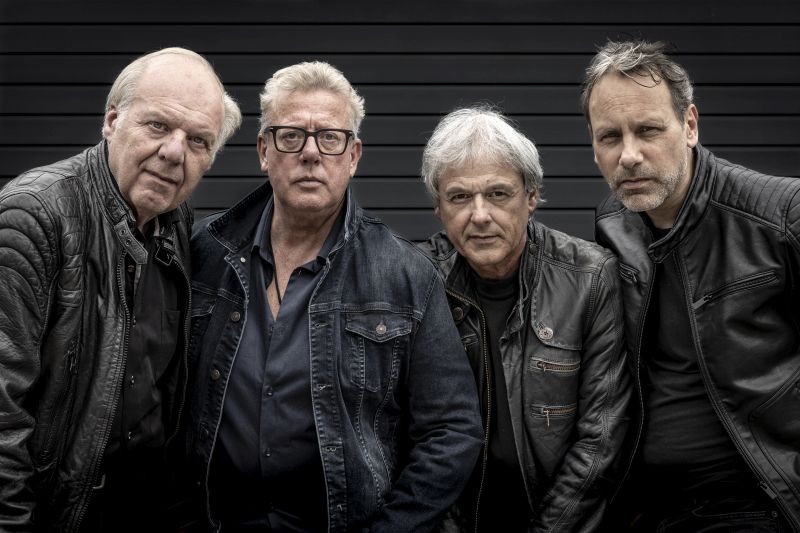
| L to R: Mike Boekhout, Ruud Stoker, Julian Driessen and Ron Koel | ||||||||||
|
How is de response of the album so far? Does the progressive rock audience like it? Ceres: "So far we have had reviews and reactions that were very positive. Also on social media we get many positive responses. Of course, it's always a matter of personal taste."
Ceres: "Yes, we will play all eighteen songs during our live performances. The experienced bass player Noud Maas is now part of The Ceres Phenomenon, so Ron is now able to concentrate on the guitar parts. At the moment we are rehearsing the set, which will also include some old songs from Timelock." Do you use projections to clarify the story? Ceres: "We're working on the idea of using projections." Ruud, will you play the role of Sentem with elaborate costumes and other paraphernalia? Ruud: "I would love to play that part to wear an extravagant space suit and heavy makeup. Maybe a bit like Fish or Peter Gabriel did." Are other singers and musicians involved to portray other roles or to play extra musical parts? Ceres: "No, it's just the four of us with Noud Maas on bass and backing vocals." What has the future in store for this project, and will there be a successor? Ceres: "First we want to do some gigs to promote the album. After that we will be working on a successor. Ruud is already writing a new story..." Thank you for answering all my questions! Ceres: "You're welcome." website youtube video 'Trapped and Uneasy' review album 'The Ceres Phenomenon' |