|
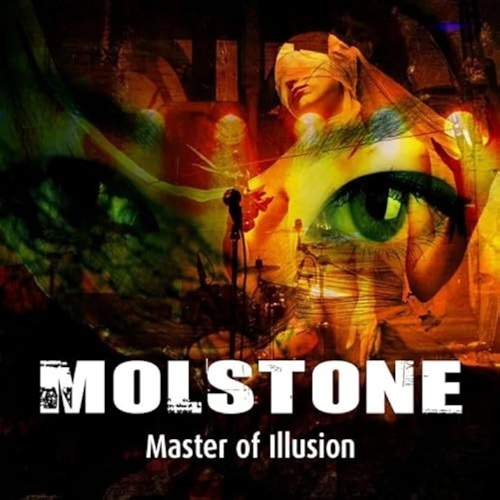
Interview Molstone (Sieberein Schaaf) "The music of Molstone is a mixture of several styles" (March 2026, text by Henri Strik, edited by Peter Willemsen) Those who closely follow the history of progressive rock in the Netherlands are undoubtedly familiar with Flamborough Head. They also know that on their first two albums singer and keyboardist Sieberein Schaaf played a significant role. His involvement with the band abruptly ended after the release of their second album Defining The Legacy in 2000. But now, after more than 25 years, Schaaf is back in the Dutch prog scene with Molstone. Recently, the band recorded the fantastic debut album Master Of Illusion (see review). As a result of this exciting news, we wanted to know what happened to him after this drastic decision in 2000. What did he do in the past 25 years, and how did he decide to become a member of the new band Molstone? Background Magazine was curious about the anwers. Your name is unmistakably linked to the history of Dutch band Flamborough Head. You sang on Unspoken Whisper (1998) and Defining The Legacy (2000). How do you feel about your musical past?
You made two wonderful albums with Flamborough Head. The second one was and still is a true masterpiece for me. However, after the CD presentation at Progfarm 2000, you decided to leave the band. What was the reason for leaving the band? "That was purely due to personal circumstances. At the time, my partner was against it. The idea of more international gigs escalated into an intense argument. For me, the pleasure of playing in a band had disappeared. The decision to quit was a bitter pill to swallow, partly because Defining The Legacy just came out with a very personal concept. A true revelation and the end of a difficult childhood. After all, it was perhaps a bit too much since there were quite a few discussions with the other band members about the lyrical content." What did you do music wise after that? "After I left Flamborough Head, I haven't done anything with music for the first few years. Only after I got divorced, I immediately started playing with a band again, but we played mainly covers." More than 25 years later, you're making a comeback with Molstone. What were the reasons for returning to the progressive rock scene? "Two years ago, Molstone decided to start working on their own compositions. I was the obvious choice to write new songs, and it is needless to say that it became prog. We started with Slave To Technology as a test track to see if all band members could agree with the new musical direction. They all responded enthusiastically, so that was the starting point." | ||||||
| ||||||
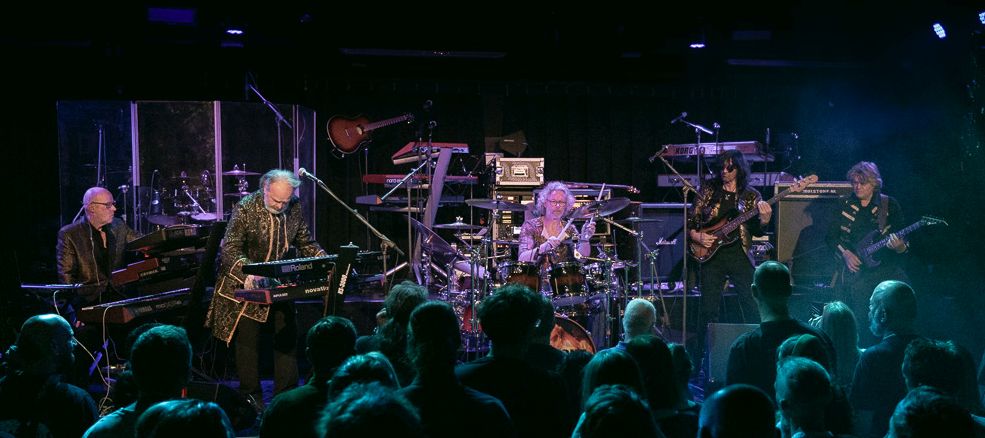
| L to R: Jan Bulthuis, Sieberein Schaaf, Klaas Hingst, Mol Mulder and Bobby Veenstra [pic by Tempus Fugit] | ||||||
|
When was Molstone founded? Would you please introduce the current band members? "Molstone started in 2014 as a rock band, playing covers of Deep Purple, Pat Travers, and Joe Bonamassa, among others. At the end of 2021, we had the perfect line-up: just a band of friends. Bassist Mol Mulder is the founder of Molstone. He asked drummer Klaas Hingst and me to join the band. Later on, guitarist Bobby Veenstra joined the band replacing the then-guitarist. I knew Bobby from my musical background." Molstone has two keyboardists in the band, just like in Flamborough Head when you were still with them. "Yes, that's correct. Keyboardist Jan Bulthuis was asked to replace me as keyboardist, so I could focus purely on singing and presentation. However, I decided to play my own music, so I also started playing the keyboards again. It was also a necessity, because of the compositions I had to deliver."
"Well, look... I wrote four of the seven songs of Defining The Legacy. I have my own way of writing, so the musical style is recognizable. The fact that there are so many similarities has everything to do with the way I left Flamborough Head. That album that had just been released, was my musical legacy! It wasn't closed for me yet! The band chose a different musical style, and for me it felt as a waste of the material. Hence this kind of transition from the past to the present. The material deserved a fresh start. Eden's Curse is a strong nod to that wonderful period, but it's not a carbon copy of Garden Of Dreams. It is a mix of several songs, hence the different title. I drew from the pool of my own compositions." Why did you call the album Master Of Illusion? Could you say that it is a concept album? 'Master Of Illusion is just a snippet of text of which we thought that it would be a suitable title for the album. No, it's not a concept album." Would you please tell our readers a bit about the songs separately?
You mention special credits for Sander Grupstra for playing the 12-string guitars. Who is he, and what did he do on the album? "Sander Grupstra is a guitarist who works at the studio where the album was recorded. Since he plays the 12-string guitar very well, we asked him to play on Gate Of Salvation and on Mind Sculpture. During the launch of the CD, he will be playing the entire show, and possibly he becomes a permanent band member." Why were the lyrics not included inside the digipack? "There are no lyrics included due to financial constraints. We have to pay for everything ourselves because the band doesn't have a source of income yet. Perhaps the lyrics will be included on the second album."
"Since Mol Mulder is a graphic designer we had all the artwork done by him." In my opinion, the album is a mix of neo-prog, prog metal, and hard rock. Do you agree? "Well, the music of Molstone is a mixture of several styles indeed. All band members contribute to the compositions. Our personal influences and preferences form the final result. There's plenty of room for ideas." Your singing on the album sometimes reminds me of a style well-known in prog metal and hard rock. Sometimes your voice sounds like Klaus Meine of the Scorpions. Can you identify with that? "I play in several bands including hard rock and metal bands. Personally, I enjoy a variable vocal style the most. Soft and sensitive, but also rough and screamy when the song calls for it. It is always possible to compare a voice to another voice, and Klaus Meine is just one of them." The album was mixed and mastered in Los Angeles by Ross Palone. What was the reason to do this in the U.S.A.? "Ross Polone is an old acquaintance of guitarist Bobby Veenstra. They worked together in the past. Ross has a proven track record since he has worked with some of the biggest names. We asked him to mix and master the album, and after two mixes we were convinced. Ross is our man, for now and in the future." You released the album independently. Were record labels not interested or didn't you look for it? "We did everything under our own management, but of course we are always interested in any acceptable offer." Did the album turn out the way you intended, or are there things you should have done differently in hindsight? "We're very happy with the end result. It was also a learning process, and we noticed that we have developed with this musical style. We are both expanding our creativity and we invest heavily in our gear. So let the gigs roll in! We're ready for it!" Website (including clips) review album 'Master Of Illusion' |