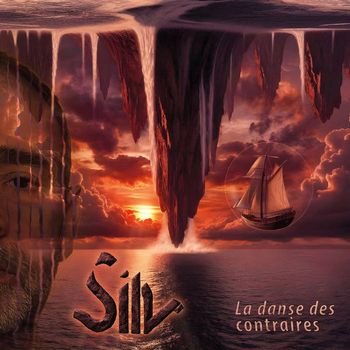
There is something particularly appealing about progressive rock when it takes an idea that might otherwise sound impossibly cerebral and turns it into something you can actually hear, feel and, occasionally, dance along with. La Danse Des Contraires, the latest solo work from French musician Silvain Goillot under the SILV moniker, is very much concerned with opposites: light and darkness, reason and emotion, structure and freedom, the organic and the electronic. Fortunately, Goillot understands that a concept is only worthwhile if the music can carry it, and this is an album where the ideas are embedded in the arrangements rather than simply pasted onto the sleeve notes. This is a French progressive rock concept album, which means two things right away: It's going to be philosophical; and it's going to be dramatic. Goillot leans into both with the confidence of someone who knows exactly how much he can get away with. Goillot is perhaps best known as the drummer and lyricist with Apairys, and that background is immediately apparent. Rhythm is not merely there to keep the other instruments moving; it is one of the album's principal compositional voices. The drumming can be intricate and restless, occasionally suggesting the influence of modern progressive metal and heavier neo-prog, yet SILV is equally comfortable allowing a piece to breathe. Quiet acoustic passages, spacious electronic textures and more fragile vocal sections are given room before the music gradually gathers momentum and explodes into its larger symphonic moments. Goillot's lyrical style is unmistakably French — poetic, intellectual, occasionally philosophical enough to make you wonder if he's trying to teach you something. But he avoids the trap of sounding like a lecture set to music. Instead, the scientific and mathematical references feel like emotional metaphors rather than academic flexing. There is something of the French chanson à texte tradition here, where the lyric demands attention, but it is placed inside a musical environment that owes considerably more to progressive rock than to conventional chanson. That combination gives La Danse Des Contraires a distinctive personality. There are moments when the vocal melodies become almost theatrical, followed by instrumental passages that open the music into considerably more expansive territory. The production is particularly important because Goillot is effectively operating as a one-man band, constructing much of the album himself. Rather than sounding like a limitation, this gives the record an unusually coherent sonic identity. The guest musicians are used intelligently rather than simply being brought in to make the credits look impressive. Jean-Christophe Rouanet, François Merlo and David Cabane add lead-guitar colour where the compositions require it, and their contributions provide some of the album's more soaring moments. Cabane is particularly important to the conceptual architecture, contributing to the composition as well as appearing on both Nuit and Jour. His presence helps establish one of the record's cleverest musical ideas: these aren't simply two songs with opposing titles, but complementary pieces whose musical DNA is deliberately connected. Nuit is the darker side of that equation. Brooding, spacious and somewhat melancholic, it settles into a shadowy atmosphere created by low-end bass, synthesizer washes and a more restrained sense of movement. It feels less like a song describing night than music inhabiting it. When Jour eventually arrives, the transformation is obvious without becoming simplistic. The musical language becomes brighter and more animated, the tempo is more volatile and the guitars are allowed to reach upwards. The contrast works because the two pieces remain related; this is opposition rather than disconnection. That idea permeates the album. Acoustic piano provides one of the most effective counterweights to the electronic machinery, with Micaël Madre and Pascal Gout supplying moments of organic warmth amid the synthesizers and heavier instrumentation. The piano doesn't merely provide decoration—it creates another texture in the ongoing argument between human and mechanical, fragile and monumental. La Danse Des Contraires is Silvain Goillot proving that he's not just a drummer who writes lyrics — he's a full-spectrum prog architect. It's ambitious without being bloated, philosophical without being pompous, and musically rich without losing its emotional thread. It's the kind of album that rewards attention. Not because it's difficult, but because it's designed — carefully, deliberately, almost obsessively. Perhaps the most successful aspect of La Danse Des Contraires is that its concept works on several levels. You can approach it intellectually, following the philosophical and scientific ideas within the lyrics, or simply let the music wash over you as a carefully constructed progressive rock journey. The two approaches don't compete. In fact, they reinforce each other. SILV has created a record about opposites, but the irony is that the music itself refuses to choose between them. Heavy and delicate, intellectual and emotional, electronic and organic, structured and atmospheric—La Danse Des Contraires works because Goillot allows all of these elements to coexist. The dance is not about deciding which side wins. It is about discovering what happens when they move together. If Apairys showed us what Goillot can do in a band, La Danse Des Contraires shows us what he can do when he's alone with his thoughts and a studio full of instruments. And honestly, it's impressive. ***+ David Carswell Where to buy? |