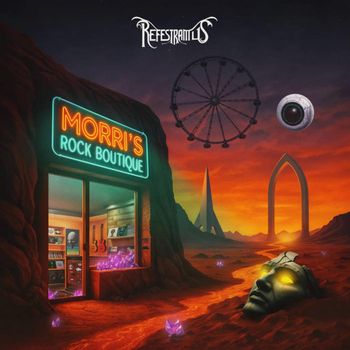
There's a certain kind of progressive rock album that doesn't so much play as it unfolds—less a sequence of tracks than a place you find yourself wandering through, half-lit and faintly familiar. Morri's Rock Boutique, the latest transmission from Refestramus, belongs squarely in that tradition. What began as a studio-bound project has quietly evolved into something more ambitious: a loosely stitched, surrealist song cycle where desert highways, neon-lit cityscapes, and half-remembered myths coexist without ever quite resolving into a single, stable reality. If Intourist hinted at a cohesive aesthetic—melding Slavic folklore, neon-lit melancholy, and classic prog architecture—Morri's Rock Boutique feels like its dream-logic successor. There's a sense throughout that bandleader Derek Ferguson is less interested in linear storytelling than in assembling emotional vignettes—snapshots of memory, myth, and dislocation. There's a cinematic quality throughout, as though you're watching a film that refuses to reveal its full frame. Scenes blur into one another; motifs recur in altered form; and just when you think you've found your footing, the ground shifts again. Musically, Refestramus draw from a deep well, but do so with admirable restraint. Progressive rock forms the backbone, certainly, yet it's filtered through jazz phrasing, classical flourishes, and occasional folk inflections that give the album a distinctly unplaceable character. There are echoes of the 1970s here—not in a nostalgic sense, but in the way melody and arrangement are allowed to breathe. The songs rarely rush; they unfold patiently, guided more by atmosphere than by any need to impress. It's eclectic, yes, but never indulgent—everything feels in service of the larger, quietly unfolding picture. The rhythmic backbone—unsurprising given Ferguson's percussive instincts—is intricate but never indulgent, while the melodic writing remains front and centre. Producer and long-time collaborator Ian Beabout once again proves indispensable, shaping a sound that is at once warm, detailed, and dynamically alive. Part of that cohesion comes from the album's rotating cast of contributors, which lends Morri's Rock Boutique the feel of a travelling troupe rather than a fixed band. Appearances from David Jackson, Rick Witkowski, Joe Deninzon, and Dyanne Potter Voegtlin add texture rather than distraction—each voice slipping into the fabric of the record without disturbing its flow. The result is a sense of constant motion, of perspectives shifting just enough to keep things unsettled. The opening stretch sets the tone effectively, drawing the listener into this fractured landscape with a sense of quiet unease. Elsewhere, pieces like Cossacks Dream rework traditional elements into something darker and more theatrical, while Hell or NYC injects a jittery, urban energy into the proceedings—its off-kilter rhythm and slightly sardonic edge recalling the skewed storytelling sensibilities of The Jazz Butcher. It stands as one of the record's centrepieces, not least for the unmistakable contribution of David Jackson. His saxophone work injects a dose of avant-prog unpredictability, recalling the restless spirit of Van der Graaf Generator at their most exploratory. It's a moment where past and present briefly converge, and it's all the more effective for it. At the heart of the album sits Deathless, a multi-part composition that acts as the album's gravitational core, exploring themes of power, mortality, and erosion with a slow-burning intensity. Elsewhere, the album continues to nod toward the classic progressive era—echoes of Genesis in the more narrative passages, hints of King Crimson in the angularity and tonal shifts—but these are filtered through Refestramus' increasingly idiosyncratic lens. By the time the closing passages arrive, the album feels less like it's ending and more like it's receding—slipping back into whatever half-imagined space it emerged from. There are no grand resolutions here, no definitive statements. Instead, Refestramus leave you with fragments, impressions, and the lingering sense that you've passed through something difficult to fully articulate but oddly affecting all the same. Morri's Rock Boutique is not a showcase for virtuosity, nor is it an exercise in retro revivalism. It's a carefully assembled, deeply atmospheric work that values cohesion and narrative suggestion over technical display. It invites patience, rewards immersion, and ultimately reveals itself not through analysis, but through experience. The album will appeal to fans of the melodic sophistication of Electric Light Orchestra, the artful storytelling of Supertramp, the whimsical edges of Klaatu, and the more oblique corners of Canterbury-adjacent prog where mood matters as much as movement. **** David Carswell Where to buy? |