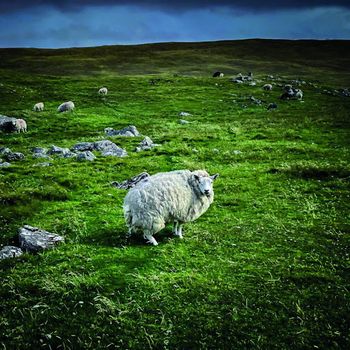
Poor Genetic Material are continuing their way of working with two different line-ups: The full eight-piece band, which releases an album every three or four years, and a smaller line-up around our core writers to fill in the gaps. What is released with the small line-up is in no way inferior to or less complex than the full group. It may be more spontaneous and a little leaner production-wise, but they take the same care concerning songwriting, arrangements and lyrics. There's a quietly confident boldness in making a pastoral progressive rock album in the 2020s — not as cosplay, not as a sepia toned retreat into Trespass-era reverie, but as a living aesthetic. Pastoral, from Poor Genetic Material, doesn't posture. It reclaims space, breath, and unhurried musical thought, and it does so with a kind of self-possession that feels earned rather than inherited. A big part of that comes from how the musicians inhabit the material. Philip Griffiths' vocals are a study in restraint — not muted, but measured, a warm and articulate presence that never forces itself into the foreground. He sings as though he's tracing the contours of the music rather than riding above it, which suits the album's reflective temperament beautifully. Stefan Glomb's guitars and bass work are equally unshowy but deeply intentional. His electric lines have that Camel-like liquidity without ever tipping into imitation, while his acoustic textures carry just a hint of Anthony Phillips' woodland clarity. He's not trying to dazzle; he's shaping the air around the songs. Philipp Jaehne's keyboards do something similar — they don't fill space so much as define it, offering soft edged harmonics, patient chordal movement, and electronic details that feel organic rather than ornamental. And Pia Darmstädter's flute is the album's secret weapon: never overused, always purposeful, adding a breath of wind through the branches at exactly the right moments. New to the fold is special guest Duncan Ness on drums and pipes. What stands out most is how comfortable the band sounds. These compositions unfold with the patience of people who trust their instincts. Themes develop quietly, arrangements stay lean, and nothing is allowed to crowd the frame. Yet the music never dissolves into ambient haze. There's a spine to it — a gentle insistence that keeps the listener engaged even when the dynamics stay soft. Lyrically and emotionally, the album circles ideas of distance, memory, and time's slow erosion. Those themes aren't just written; they're embedded in the pacing, the harmonic choices, the way motifs return like half remembered thoughts. It's an album that rewards stillness and repeat visits. Yes, you can hear the lineage — a brush of Camel here, a flicker of early Genesis there — but these are passing shadows, not guiding lights. Poor Genetic Material have long since stepped out of the "influenced by" conversation, and Pastoral feels like one of their most self-defined statements. If there's a limitation, it's that the album rarely breaks its own spell. Those craving dramatic peaks or virtuoso pyrotechnics may find themselves waiting for a moment that never arrives. But that's NOT a flaw so much as a choice. This is music built on nuance, atmosphere, and the confidence to stay within a carefully drawn emotional palette. My personal favourite tracks are Fur And Skin and the epic title track Pastoral. In the end, Pastoral lingers. It's cohesive, quietly assured, and deeply attuned to the strengths of the musicians who made it. It doesn't demand attention; it invites it. And if you give it that attention, it stays with you long after the final chord fades into silence. What makes the album work is its sincerity. There's no irony, no attempt to modernize for the sake of relevance. It's prog as a living tradition — not a museum piece, but a craft. And while it may not push boundaries, it absolutely honours them. **** David Carswell Where to buy? |