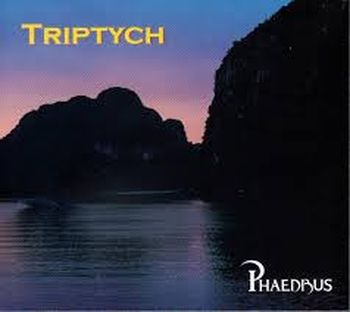
There are albums that arrive with all the subtlety of a brick through a window, and then there are those that quietly open a door into somewhere rather more interesting. Triptych by Phaedrus belongs firmly in the latter category. Originally issued in 2017 as an exclusive collector's item for subscribers to the Phaedrus digital magazine, this intriguing collection has finally been made available to the wider public—and, rather appropriately, has been given a fresh lease of life in the form of a 2026 high-resolution remaster undertaken by Carlos Plaza himself. And what a curious beast it is. At its heart, Triptych is a meeting point between symphonic progressive rock, chamber music, avant-garde experimentation and occasional jazz-inflected excursions. It is not an album that seems particularly interested in staying in one musical room for very long. Instead, Plaza and his impressive collection of collaborators continually move the furniture around, knock down a few walls and occasionally open a window onto something completely unexpected. Triptych is what happens when symphonic progressive rock wanders into a room full of classical musicians and nobody calls security. It's eclectic in the best way — not "we threw everything at the wall," but "we built a wall strong enough to hold everything." What you end up with is symphonic prog with the confidence of someone who's listened to way too much early Camel, chamber music that feels like it escaped from a conservatory recital and jazz touches that appear just long enough to remind you these players can improvise circles around mere mortals. That balance between composition and experimentation is ultimately what makes Triptych such an interesting proposition. The musicians on Triptych play with the kind of collective intuition you only get when everyone in the room is both highly trained and slightly fearless. César G. Forero's guitar work acts like a narrative thread, never showboating, always guiding, while Omar Acosta's flute slips through the arrangements with a kind of aerodynamic elegance that makes every passage feel lighter than it has any right to be. José Luis Espejo brings a clarinet voice that adds chamber‑music sophistication, the sort of timbre that instantly deepens the emotional palette. Jaime Pascual's bass is warm and melodic, quietly shaping the foundation without ever demanding attention, and Carlos Franco's drumming is the rare prog percussion that understands restraint — precise, tasteful, and allergic to clutter. Then there's Miguel Rosell on cello, the emotional ballast of the whole project, grounding the more experimental edges with a rich, human resonance. Together, they form an ensemble that doesn't just perform Plaza's compositions — they inhabit them, giving the album its unmistakable sense of intention and cohesion. This isn't progressive rock designed around obvious hooks or the obligatory twenty-minute epic. Nor is it avant-garde music for the sake of being difficult. Instead, Carlos Plaza has created something considerably more organic: a collection of pieces where guitars, flute, clarinet, cello, bass and drums are allowed to converse with one another. The 2026 remaster is therefore more than a convenient excuse to resurrect an old release. Bringing the album into 24-bit/48 kHz high-resolution territory gives this detailed instrumentation an opportunity to breathe, and Triptych is certainly an album where those details matter. The acoustic instruments, in particular, benefit from the additional clarity, allowing the listener to appreciate just how much is happening beneath the surface. There are moments when the album's eclecticism can make it feel slightly elusive. This isn't necessarily music that reveals everything on the first listen. But that's also part of its appeal. Triptych isn't particularly interested in holding your hand. It presents its ideas, allows them to collide, mutate and disappear, and leaves you to make sense of the resulting musical landscape. For those who discovered Phaedrus through the earlier digital magazine years, this release will presumably carry an additional sense of history. For everyone else, it represents an opportunity to discover a fascinating little piece of the Phaedrus story that was previously restricted to collectors and subscribers. In the end, Triptych is precisely the sort of album that makes you appreciate why progressive music continues to exist outside the boundaries of genre. It is adventurous without being gratuitously obscure, sophisticated without becoming sterile, and eclectic without completely losing its sense of direction. A fascinating and adventurous piece of eclectic progressive music—and one that has certainly earned its second life. **** David Carswell Where to buy? |