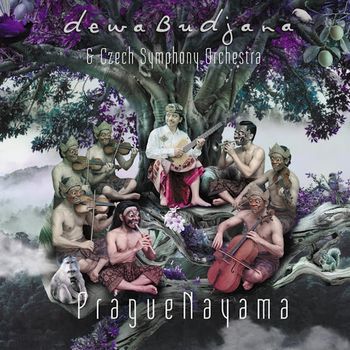
There are albums that announce themselves with fireworks and virtuoso excess, and then there are albums that seem to arrive like weather — slowly surrounding you until you suddenly realize you're standing in the middle of something immense. PragueNayama, the latest collaboration between Dewa Budjana and the Czech Symphony Orchestra, belongs firmly in the latter category. This is not an EP interested in dazzling listeners through technical acrobatics alone. Instead, it aims for something deeper: mood, reflection, atmosphere, and perhaps even a little transcendence. Budjana has long occupied an intriguing space in progressive music, sitting comfortably between jazz fusion, world music, and progressive rock without ever appearing bound by any of them. Here, he stretches even further. Recorded at Czech Television Studio in less than a day — an almost absurd fact considering the scale and cohesion on display — PragueNayama feels remarkably organic. There's an immediacy to the performances that gives the orchestral passages a sense of life rather than polish-for-polish's-sake. Nothing feels overworked. The orchestra breathes, swells, and shifts naturally around Budjana's guitar lines. Stylistically, there are moments that bring to mind the adventurous spirit of Bruford's more exploratory work, alongside flashes of the jazz-fusion elegance of John McLaughlin. Elsewhere, Budjana's phrasing occasionally recalls the atmospheric lyricism of Pat Metheny, particularly in the way melodies drift rather than charge. But these are points of orientation rather than direct comparisons. Budjana's voice remains entirely his own — ethereal, expressive, and refreshingly unconcerned with proving how many notes he can fit into a bar. And that may be one of the album's greatest strengths. There's an admirable restraint here. Guitar heroics take a back seat to emotional storytelling. Budjana paints rather than shreds. His guitar frequently acts as narrator, floating through orchestral landscapes that shift from grand and cinematic to intimate and deeply personal. The East-West synthesis at the heart of PragueNayama never feels forced either. Indonesian textures, including kendang percussion and handpan, are woven naturally into the orchestral framework rather than pasted on as "world music" decoration. The result is a genuine conversation between traditions. Even the rhythm section contributes heavily to the album's emotional pull, particularly the fretless bass work of Shadu Rasjidi which deserves its own award. It glides, it sings, it occasionally threatens to steal the whole show with melodic instincts that often become as memorable as Budjana's guitar themes. If Jaco Pastorius ever had a spiritual grandchild, this might be him. Emotionally, PragueNayama operates in fascinating territory. It can be melancholic one moment and quietly euphoric the next. There's a meditative quality running throughout — not in the sense that the music fades into the background, but in the way it encourages stillness and attention. Some records demand analysis; this one asks you to simply sit inside it for a while. What ultimately makes PragueNayama so compelling is its maturity. Many fusion albums still fall into the trap of becoming demonstrations of capability. Budjana seems uninterested in that game. Instead, he delivers emotional architecture — carefully constructed soundscapes designed to create feeling before spectacle. This may not be the album for listeners searching for relentless complexity or instrumental excess. But for those willing to surrender to its pace and atmosphere, PragueNayama becomes something richer: a spiritually resonant and deeply immersive journey that lingers long after the final notes fade. **** David Carswell Where to buy? |