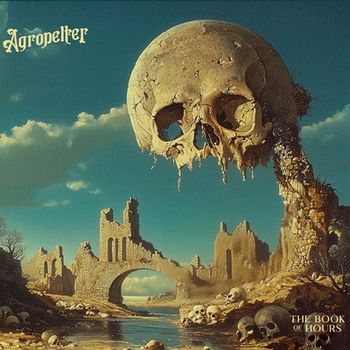
In the early 90s I started to write about prog for several Dutch prog magazines, within a few months I was flooded with promo CD's by new Skandinavian prog bands (especially Sweden, and Norway), from Anekdoten and Änglagård to Landberk and White Willow. Their music was obviously inspired by 70s Yes, Genesis, King Crimson and Pink Floyd, and layered with vintage keyboards, with an omnipresent Mellotron sound. I had to think about this when I listened to current Norwegian bands/artists Lars Frederik Froislie (ex-White Willow), Kornmo and Anders Buaas, and most recently Agropelter, this review is about the latter, with their debut album entitled The Book Of Hours. Band info. "The known USA prog label The Lasers Edge presents this captivating debut release from Norwegian instrumental progressive rock project Agropelter. Agropelter is the creative outlet of multi-instrumentalist Kay Olsen (from vintage keyboards and guitars to bass, harps, Moog Taurus bass pedals and percussion), a new contender on the blossoming Norwegian prog scene. The music lends as much inspiration from the classic prog groups like Genesis, Camel, King Crimson, and Eloy, as it does from classic composers Rachmaninoff, Beethoven, Bach, along with Vangelis and Terje Rypdal. The album also features guest musicians Jonas Reingold (Steve Hackett, The Flower Kings, Kaipa, Karmakanic) on fretless bass, Andreas Sjøen (Umpfel, VÅDE, Sean Ashe) on drums, and Mattias Olsson (Änglagård, White Willow, Molesome) handling percussion, vintage synth overdubs, and atmosphere, as well as a wide array of classical musicians providing various strings and woodwinds." The first part of this instrumental album contains 3 shorter tracks, between 2 and 6 minutes. 1.Flute Of Peril: The intro delivers a high pitched flute and the sound of waves, then Mellotron violins, acoustic guitar, and finally synthesizers join, "folk meets symphonic rock", like early Anglagard, beautiful. 2.Levitator: First the sound of waves, soon blended with synthesizer runs and howling electric guitar, next a pumping bass, then a tight beat, embellished with a fiery guitar solo with biting runs. Halfway the mood shifts to dreamy, with pleasant work on guitar and keyboards (like the Neo-Prog by Pendragon). Next an interlude featuring a sumptuous church organ sound and in the end again the sound of waves. 3.Burial Mound: This track is close to ambient. The atmosphere is a perfect musical translation of the dark title, pretty melancholy featuring first slow percussion sounds, ominous keyboards and then tender fretless bass runs blend. This band doesn't stop to surprise and delivers interesting and varied musical ideas. The second part of this album contains the title track in four parts. 4.The Book Of Hours Pt I: First tender piano runs, in a classical climate, turning into bombastic featuring powerful Hammond waves and fat Moog flights, with a tight mid-tempo beat, heavy guitar riffs join, and spectacular Minimoog, harder-edged guitar, and propulsive drums, what an exciting Heavy Prog (evoking Ayreon), wow. Halfway the mood shifts to dreamy with Grand piano, between tender and sparkling. Now bombastic Hammond and Minimoog and powerful drum beats, in a slow rhythm. Next a blend of Mellotron choir eruptions, electronic music beeps and bleeps, and a fretless bass solo, a nice musical idea. And finally hypnotizing piano runs, in an atmospheric climate, and in the end a short bombastic grand finale with Mellotron choirs. What variety and dynamics, the one moment classical overtones, the next moment Heavy Prog or symphonic rock, wow. 5.The Book Of Hours Pt II: The intro delivers the distinctive Hammond organ with Leslie tremolo sound, I love it! Then Minimoog flights blend, typical Rick Wakeman style. Next a compelling, a bit hypnotizing climate, in a slow rhythm, with fat Minimoog runs, and tender piano, a fine contrast, creating tension. Now an accellaration, in a mid-tempo, with Minimoog and Mellotron choir, again strong Rick Wakeman hints. The second part features a spacey synthesizer solo, followed by a sensitive electric guitar solo, and sparkling piano play in between. Then the atmosphere turns into electronic, evoking Vangelis, and finally tender Grand piano. 6.The Book Of Hours Pt III: First a catchy beat with a fat and funky synthesizer sound, then spacey Minimoog flights with pitchbend, in a slow rhythm. Halfway the music turns into mellow with spacey synthesizer and soaring strings, and tender piano. Next moving electric guitar and classical piano, joined by Mellotron sounds, culminating in a sumptuous eruption with powerful Hammond and fat Minimoog flights. Now the mood shifts to a catchy mid-tempo beat with heavy guitar leads and bombastic Minimoog with sensational pitchbend. Next another sumptuous eruption, with Mellotron choirs and powerful drum beats, and a heavy guitar solo with Mellotron choirs, top notch Heavy Prog. 7.The Book Of Hours Pt IV: After a tender classical piano intro lots of shifting moods (from classical and symphonic rock to Heavy Prog and electronic) and breaks, embellished with excellent work on keyboards, from harpsichord and majestic Mellotron choirs to delicate synthesizer flights. This is topped with moving electric guitar and churchy Hammond, the final part delivers a wonderful build-up and bombastic grand finale, what a strong conclusion. Multi-instrumentalist Kay Olsen presents a varied, dynamic and captivating album, tastefully arranged, and loaded with very pleasant work on vintage keyboards and guitar. He has surrounded himself with excellent musicians, a very inspiring musical climate. If you are up to varied compositions with omnipresent vintage keyboards this a very interesting album to discover. **** Erik Neuteboom (edited by Tracy van Os van den Abeelen) Where to buy? |